


Türkiye’s Karahantepe Unearths the First Three-Dimensional Narrative of the Neolithic Age
Archaeologists working at Karahantepe, one of the world’s most significant Neolithic sites in Türkiye, have announced what is being hailed as the discovery of the century: the earliest known three-dimensional mythological depiction. Dating back 12,000 years, this extraordinary find marks the first evidence of prehistoric storytelling expressed through carefully arranged objects, offering fresh insight into how early societies preserved memory, myth, and meaning.
A Groundbreaking Discovery
The new find was uncovered inside a sealed chamber filled with red sterile soil. Within it, researchers found stone vessels and plates stacked neatly together, accompanied by carved animal figurines, stone batons, beads, and animal bones including wolf jaws, leopard remains, and vulture and fox skeletons.
Among the most striking artefacts was a bottomless vessel containing three miniature figurines — a fox, a vulture, and a wild boar — each carefully positioned with its head resting inside a carved stone ring. A stone lid covered the vessel, preserving the composition for millennia.
While these animals are often depicted in large-scale engravings and reliefs at Neolithic sites, the discovery of small figurines deliberately arranged in this way is unprecedented. The careful placement of the figurines inside one vessel, which itself was placed within a larger vessel, transforms the find from a simple collection of objects into a symbolic narrative — the world’s first known example of three-dimensional storytelling.
Why It Matters
Previous discoveries in the Şanlıurfa region — home to globally renowned sites like Göbeklitepe — have mostly consisted of two-dimensional depictions carved into immovable pillars, benches, or walls. This breakthrough shows that early societies were not only capable of symbolic representation but also used spatial arrangement to communicate shared beliefs and collective myths.
According to archaeologists, this represents a turning point in our understanding of Neolithic art and communication. It demonstrates how prehistoric communities developed complex symbolic systems far earlier than previously thought.
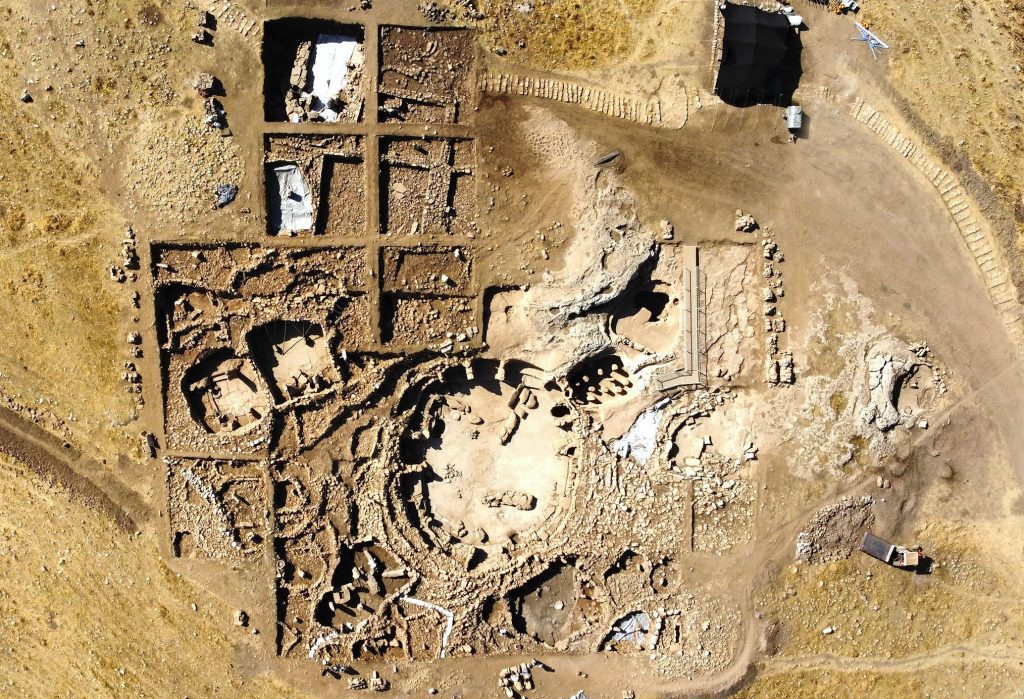
Karahantepe and the Taş Tepeler Region
Karahantepe is part of the Taş Tepeler (“Stone Hills”) region, which encompasses 12 archaeological sites regarded as the cradle of the world’s earliest settled communities. Türkiye has designated the area as part of its “Legacy to the Future Project,” ensuring these discoveries are preserved, studied, and shared with the world.
The significance of the region continues to grow. In 2024, Göbeklitepe alone welcomed more than 709,000 visitors, many of whom also travelled to Karahantepe to witness its awe-inspiring remains.
The latest artefacts are currently on display at the “Golden Age of Archaeology” exhibition at the Presidential Complex Exhibition Hall in Ankara, alongside other major finds and repatriated treasures, underlining Türkiye’s commitment to protecting and celebrating its archaeological heritage.
Türkiye: Where Civilisations Converge
Situated at the crossroads of Asia and Europe, Türkiye has long been a hub of cultural exchange. Today, it remains one of the world’s most captivating destinations, drawing more than 62 million international visitors in 2024. With its unparalleled blend of history, nature, gastronomy, and art, Türkiye continues to inspire travellers and scholars alike.
For more information on visiting Türkiye, explore www.goturkiye.com