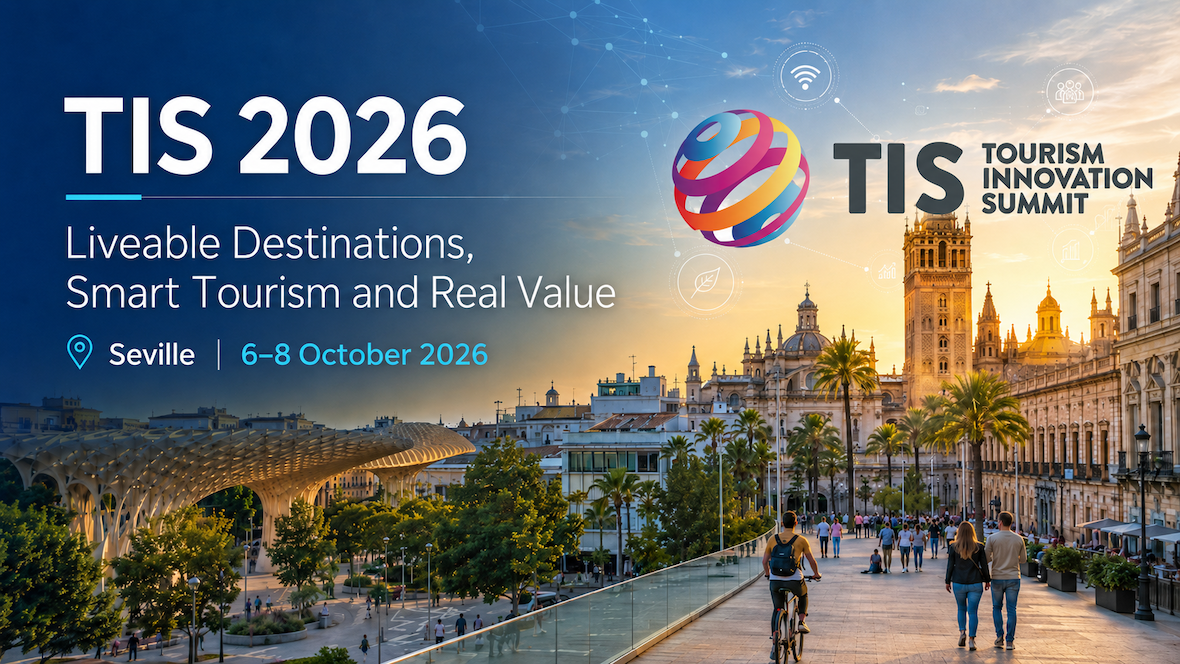
TIS – Tourism Innovation Summit will examine how destinations can move beyond visitor numbers and use data, collaboration and new business models to create value for residents, visitors and local economies.
TIS – Tourism Innovation Summit will return to FIBES Seville from 6–8 October 2026. More than 8,000 tourism and travel professionals are expected to attend. The event will also bring together over 200 travel technology companies and more than 400 international speakers. This year’s programme places a strong focus on a question facing destinations worldwide. How can tourism continue to generate jobs and investment without weakening residents’ quality of life or placing unsustainable pressure on local resources? Technology remains central to the summit. However, many sessions will examine what the technology should achieve in practice. The goals include better management of visitor flows, stronger local economies, nature recovery and a fairer balance between visitors and residents.
Click to list of hotels In Seville
Tourism success is being redefined
For many years, destinations measured performance mainly through arrival numbers, overnight stays and visitor spending. Those indicators remain important. Yet they do not show how tourism affects housing, transport, public spaces, heritage sites or community support. The debate is particularly relevant in Spain. The country welcomed a record 96.8 million international tourists in 2025, according to Spain’s National Statistics Institute. International visitor spending reached €134.7 billion, an increase of 6.8% on the previous year. The challenge is therefore not simply to attract more visitors. It is to increase the value created by tourism and distribute demand more effectively. Destinations must also retain the support of the people who live and work in them. This shift is reflected in the TIS session, “The Livable Destination: Balancing Tourism Growth and Quality of Life”. It will consider how cities can support residents, visitors and businesses at the same time. Economic growth, sustainability and global competitiveness will form part of the discussion.
Another session, “Technology at the Service of the Citizen”, will examine the social acceptance of tourism. It will look at how digital tools, analytics and urban management can reduce tensions and improve coexistence between visitors and local communities. The programme will also address the need to rebuild public trust. “Regaining Legitimacy: How Destinations Rebuild Trust with Residents” is scheduled for the second day. These discussions recognise that tourism policy cannot be separated from city management. Transport, housing, public services, planning and the visitor economy increasingly overlap. UN Tourism also identifies the management of urban tourism flows for the benefit of visitors and residents as a fundamental industry issue.
Moving from data collection to real decisions
Smart destination systems have created large quantities of information. Cities can now monitor accommodation demand, transport use, visitor movement, online sentiment and pressure on attractions. The next step is to turn that information into timely decisions. “The Future of Smart Destinations: From Data to Real Impact” will explore how destination management organisations can move beyond trials and dashboards. The session will focus on practical strategies that improve the visitor experience, manage flows and support sustainability. It will also consider the long-term value created for residents and local economies.
Related sessions will look at real-time tourism control centres, big-data ecosystems and Spain’s Smart Destination Platform. “Building a Meaningful Destination through Data & Innovation Ecosystems” will examine how organisations can connect isolated projects and turn intelligence into action. This approach is consistent with wider European tourism policy. The European Tourism Dashboard monitors environmental, digital and socio-economic indicators. Meanwhile, Spain’s smart destination model is built around five connected areas: governance, innovation, technology, sustainability and accessibility. A destination does not become smart simply by installing more technology. It must connect data with governance, public services and measurable benefits.
From volume to value
TIS 2026 will also examine how destinations can target demand more carefully. “Spain in the Global Travel Map: From Volume to Value Champion” will consider how Spanish destinations and companies can respond to increasing social and regulatory expectations. The Netherlands will provide another international example. The keynote “Destination DNA: Matching the Right Visitors to the Right Places” will outline the country’s approach to tourism growth towards 2035. It will explain how value-based segmentation can match visitors with the character of different places. This can help spread demand and improve marketing efficiency. The same commercial logic extends to meetings and events. A dedicated session will examine how destinations compete for high-value congresses, conventions and incentive travel. Infrastructure, air connectivity, sustainability and a distinctive local offer are becoming important parts of the bidding process. This is not an argument against growth. Instead, it asks destinations to be clearer about the type of demand they want, when they want it and the benefits it should deliver.
Encouraging visitors to contribute
One of the most practical case studies will come from Copenhagen. Its CopenPay programme rewards visitors for actions that benefit the city. These can include cycling, using public transport, collecting litter or volunteering in an urban garden. Rewards can range from museum admission to guided tours, bike hire and refreshments. The initiative began as a pilot in 2024 and expanded in 2025. It became a year-round programme in June 2026. Wonderful Copenhagen says more than 30,000 people have participated since its launch. Over 100 destinations have also expressed interest in the model.
The TIS session, “Turning Visitors into Contributors through CopenPay – One Choice at a Time”, will show how a destination can use positive incentives to influence behaviour. It moves sustainability from a marketing message into the visitor experience. The model also demonstrates the importance of local partnerships. Cultural attractions, hotels, restaurants and other organisations provide the rewards. Visitors gain a more meaningful experience, while positive actions support the destination. Further details about the programme and its results are available from Wonderful Copenhagen.
Nature-positive and rural tourism
Environmental management will form another important strand of TIS 2026. “Proven Models: Innovating Tourism to Protect and Regenerate Nature” will examine practical frameworks for nature-positive tourism. The emphasis will extend beyond reducing harm. Businesses and destinations will be asked how tourism can actively support ecological recovery. The summit will also host the Tourism4Nature Awards. Entries are being assessed across areas such as biodiversity protection, conservation, restoration, responsible use of natural resources, environmental education and territorial cohesion.
Rural tourism will receive dedicated attention on the final day. The Rural Tourism Observatory 2026 session will examine changing traveller demand and the strategies helping smaller destinations to differentiate themselves. It will also consider how tourism can contribute to sustainable development in local communities. These topics connect environmental goals with economic opportunity. Rural and nature-based destinations need viable businesses, skilled employment and year-round demand. At the same time, growth must protect the landscapes and heritage on which their visitor economies depend.
International destination leaders at TIS 2026
The announced speaker line-up includes executives from global travel, hospitality, government and destination organisations. Destination voices include Jana Adamcová, Vice-Chair of the Board of Prague City Tourism, and Rikke Holm Petersen, Director of Marketing, Communication and Behaviour at Wonderful Copenhagen.
Other announced speakers include María Velasco González, Director of Tourism Research, Development and Innovation at SEGITTUR. They also include Jóhan Pauli Helgason of Visit Faroe Islands and Maiju Viiki of Tampere, European Capital of Smart Tourism 2026. Pedro Homar Oliver, Managing Director of Fundación Turismo Palma 365, is also due to participate.
Argentina will participate as Destination Partner 2026. Its presence will add a Latin American perspective to discussions about destination identity, regional development and innovation. The Tourism Innovation Global Summit will run across five simultaneous auditoriums. Its content will be organised through four vertical forums covering hospitality and accommodation, destinations and experiences, travel distribution and agencies, and leadership, innovation and scale.
Six specialist agendas will serve CEOs, technology leaders, destination managers, marketing and sales leaders, talent professionals and institutional decision-makers. Delegates will also have access to the exhibition, Touristech Startup Fest, networking activities and business matchmaking. The format is designed to connect policy and strategy with technologies that tourism organisations can implement.
A timely debate for the visitor economy
The destination strand makes TIS 2026 more than a showcase for travel technology. It places the sector’s tools within a wider public and commercial debate. Data can help a city predict congestion. Incentives can encourage visitors to make more responsible choices. Better segmentation can spread demand. Regenerative projects can channel tourism income towards nature and local communities. However, each approach depends on leadership, cooperation and clear measures of success.
The central question in Seville will therefore be practical: what outcomes should tourism growth produce? For destinations under pressure, the answer can no longer be based on visitor totals alone. TIS – Tourism Innovation Summit takes place at FIBES Seville from 6–8 October 2026. Visitor opening hours are 09:30–18:30 on 6 and 7 October, and 09:30–15:00 on 8 October. Programme details and registration are available through the official TIS 2026 website. The programme may be updated before the event.
TIS – Tourism Innovation Summit www.tisglobalsummit.com